- Rose Cut Diamond Bandeau Tiara
- Ruby Peacock Motif Tiara
- Mellerio Ruby Tiara
- Diamond Festoon Tiara
- Aquamarine Parure Tiara
- Mellerio Sapphire Tiara, diamond setting
- Emerald Tiara, with pearls
- Emerald Tiara
- Pearl Button Tiara
- Pearl Button Tiara, topped with Queen Emma's Diamond Stars
- Antique Pearl Tiara, without pearls
- Antique Pearl Tiara, with pearls
- Queen Wilhelmina's Diamond Haircomb
- Mellerio Sapphire Tiara
- Queen Emma's Diamond Tiara
Wednesday, January 30, 2013
"Queen" Maxima's Tiaras
Saturday, October 20, 2012
Luxembourg Royal Wedding! Part 1: The Bride
I sadly didn’t see this wedding live, unlike the wedding of the Duke and Duchess of Cambridge, and the Prince and Princess of Monaco. Anyhow, after the pre-wedding last night and all the good looking guests. I was wondering how everyone looked today. Well, there were so many wedding guests at we will have a double post!
Stephanie walked down the aisle in a Elie Saab Couture. It was, in some ways, exactly what you’d expect from this designer. He certainly has a couture style, which is part of the reason why I love his work: you can tell this stuff is couture from a mile away, every tiny embellishment expertly completed by hand. And in the case of this dress, that personal effort took 3,200 hours for embroidery from a team of 15 people and 700 hours from a team of 10 seamstresses.
She wore a Lannoy family tiara, made of platinum and diamonds with a large inverted pear shape diamond in the high center. It was made by Althenloh of Brussels and was worn by Stéphanie’s sisters and sisters-in-law at their weddings. She also wore diamond earrings, a delicate necklace, and her late mother’s engagement ring as well as her own.
The train, I say, looked amazing! It fit the dress well, it wasn’t taking the attention away from the dress. But, it wasn’t too short, for the dress.
The veil was placed inside of Stephanie’s bun-updo that she had. The veil had flower details on it, much similar to the train.
Last but not least, the very magical kiss that this balcony hasn’t seen in MANY years… they are just a great couple! I nominate them as the cutest couple of the year. Who’s with me?
Wednesday, June 6, 2012
Wedding Wednesday: Queen Elizabeth’s Wedding Dress
HRH Princess Elizabeth of York and Lieutenant Philip Mountbatten
November 20, 1947
Westminster Abbey, London
In 1947, Princess Elizabeth married her love, Lieutenant Philip Mountbatten. This wedding was in the middle of the war, and many people all over Britain felt every happy when Elizabeth said she was engaged to Prince Philip.
Elizabeth chose a court dressmaker, Norman Hartnell for her wedding dress duty. Hartnell got the inspiration of the gown from Botticelli’s painting, Primavera. (Above Left). The sketch (Above Right) was a dreamy creation in ivory duchesse satin.
Princess Elizabeth had to fund her gown with clothing coupons. She was given 200 extra coupons by the government. People sent in their own coupons to help the Princess out (these were sent back with a note of thanks, it was illegal for her to use them). The public had to be reassured that the silkworms used to create the gown came from China, rather than enemy countries. The gown was heavily embroidered with thousands of seed pearls (flown in from the United States), silver thread, crystals, and tulle appliqués.
The train was silk tulle embroidered in a star pattern that extended 13 foot back. The silk tulle veil was shorter than the train, leaving the embroidery to be the star of the show.
The bride accessorized with sandals in ivory duchesse satin fastened with a silver buckle ornamented with yet more pearls. Her bridal bouquet was made of white orchids, myrtle and was sent back to the Abbey the day after the wedding to rest on the Tomb of the Unknown Soldier. Her bouquet was temporarily lost until someone remembered it was in a refrigerator. The shorter of her two pearl necklaces was the 'Queen Anne' necklace, said to have belonged to Anne, the last Stuart Queen; the longer 'Queen Caroline' necklace. Both were left to the Crown by Queen Victoria and were given to Elizabeth as a wedding present by her father, King George VI. In another mishap, both were left on display with the rest of the gifts at St. James Palace and had to be fetched through the crowds. They were returned to Buckingham Palace with minutes to spare before the bride's departure. Her earrings were a 20th birthday present from Queen Mary, who had inherited them from her mother. The bride also wore Queen Mary’s Fringe Tiara.
Tiara Wednesday: Girls of Great Britain and Ireland Tiara
With the end of the Diamond Jubilee, we may as well have a diamond tiara.This would have to be my favourite diamond tiara, need to explain? Let’s get into the diamond tiara magic!
This is one of the many wedding present to the future Queen Mary that she received in 1893. The tiara was given to Mary by a committee that was chaired by Lady Eve Greville. The committee raised over £5,000 and bought the tiara from Garrard, after they donated the rest of the money to charities.
The tiara is designed by festoons and scrolls set on a bandeau of round and lozenge-shaped diamonds. It was topped with nine large pearl finals (left), originally. In 1914, Mary took them off, she replaced them with simpler diamond collets, she also removed the bandeau.
1947, Mary gave this tiara to her granddaughter as a wedding present. Elizabeth is said to call this tiara “Granny’s tiara”. As mentioned in Diana’s Jewels. Right after the wedding, with any given tiara occasion, she wore it. The tiara became a frequent worn piece by the Princess.
It is said that Elizabeth didn’t know there was a bandeau to the tiara until after Mary’s death in 1953. Elizabeth added the Bandeau to the originally tiara in 1969.
Tuesday, May 29, 2012
Tiara Tuesday: Boucheron Honeycomb Tiara
The tiara I just posted was from last week, my computer was being stupid and it wouldn’t post so, we have a double tiara day.
This tiara was made by Boucheron for the Hon. Mrs. Greville (a well-known society maven) in 1921 out of stones salvaged from another tiara. Having no heirs of her own, she left her considerable jewel collection to Queen Elizabeth (the future Queen Mother) when she died in 1942. King George VI was a little uncertain about accepting the jewels.
She had Cartier make it bigger, by adding a little variation to the top line and finishing it off with a marquis-shaped diamond in the center. A change for the better, if you ask me: it needed some pizazz to take it from "giant wall of diamonds" to "giant wall of diamonds with decorations on top".
The Boucheron was destined to become one of her favorites. Indeed, in the Queen Mother's later years, it was one of only two from her collection that she wore publicly.
When the Queen Mother died, her jewels passed to Queen Elizabeth as a sovereign to sovereign inheritance. The Queen has now doled this tiara out to the Duchess of Cornwall, which is a nice nod to the grandmother Prince Charles loved so much. She first wore it for her third tiara appearance, in 2006, and it's been the only one she's worn since.
I wasn't a big fan of this tiara until Camilla started wearing it. It does have a bit of a basket feel to it, and it's one of those pieces that's surprisingly modern for its time. The Queen Mother had a tendency to wear it alongside more traditional pieces, such as Queen Alexandra's pearl and diamond wedding necklace (center photo, Queen Mother collage above).
Tiara Tuesday: Oriental Circlet
Following the Diamond Jubilee celebrations – we have the Oriental Circlet.
Prince Albert made this tiara for Queen Victoria, this piece made by Garrard in 1853 for around £860. It's a big tiara: the original diadem consisted of more than 2,600 diamonds with opal accents, all set in gold. Opals were one of Albert's favourite stones, and after receiving this tiara Victoria commissioned an opal necklace, earrings, and brooch to go with. The opals have since been replaced with rubies (and you will accordingly sometimes see this referred to as the Indian Ruby Tiara or even just the Indian Tiara).
Many changes have occurred since the tiara was created. For the initial design, Victoria supplied around half of the diamonds from her existing collection. The Hanover diamonds were removed in 1858 and replaced by a mix of diamonds taken out of other royal jewels and new ones from Garrard.
Queen Victoria left this set to the Crown in her will, and when Queen Alexandra inherited it after Victoria's death she changed it again. Apparently believing opals to be unlucky, she replaced them with rubies from a necklace given to Queen Victoria by the ruler of Nepal. She also reduced the size of the tiara: there were originally 17 opals and arches, but only 11 rubies and corresponding arches exist on the piece today. For all the changes she made, the tiara doesn't seem to have been a favourite of Queen Alexandra - well, at least enough of a favourite to wear for portraits and the like - and the same goes for Queen Mary. It passed to Queen Elizabeth (the future Queen Mother) when her husband inherited the throne, and she finally made good use of the revised tiara.
Despite having multiple tiaras to choose from, the Queen Mother used only two in her later years. She often paired it with the magnificent set of huge rubies which was once set with opals, just like the tiara, and was also left to the Crown by Queen Victoria.When the Queen Mother died in March of 2002, the tiara passed to her daughter, Queen Elizabeth, along with the rest of her estate. This is one of the pieces that she technically could have asked for earlier - after all, it was left to the Crown, and she's been in charge of the Crown since 1952 - but she let it be, supposedly saying "Mummy will give them back."
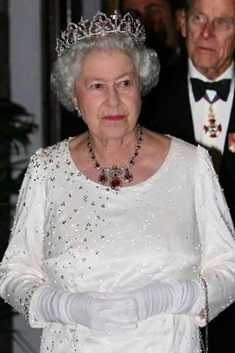
Queen Elizabeth debuted the tiara during a state visit to Malta in 2005 - and we've not seen it publicly since (despite my fervent wishes that she'd swap in this one and swap out the Burmese Ruby Tiara in her regular tiara rota).
Tuesday, May 15, 2012
Tiara Tuesday: Burmese Ruby Tiara
The Queen received the rubies from the people of Burma as a Coronation gift. She sent the rubies to Garrad’s to create a new tiara in 1973. She selected a design where the rubies were arranged in clusters like the Rose Of England surrounded by diamonds. The Queen wears the crown often with her many ruby necklaces and bracelets. Since the passing of the Queen Mother, she has worn the magnificent ruby necklace, The State Rubies, left to the Crown by Queen Victoria.
Wednesday, May 9, 2012
Wedding Wednesday: The Queen Mother’s Wedding Dress
HRH The Duke of York and Lady Elizabeth Bowes-Lyon
April 23, 1923
When Lady Elizabeth Bowes-Lyon married Prince Albert, the Duke of York, on April 23, 1923 at Westminster Abbey, she became one of the trendiest royal brides...well, ever.
Her gown was crafted by Madame Handley Seymour, a former court dressmaker for Queen Mary, but it certainly wasn't your typical court dress. The design followed the Coco Chanel-dictated trends of the time: dropped waists, silhouettes without much shape.
The gown is silk crepe moire embellished extensively with pearls and silver embroidery. The detail and weight of the decoration gives the dress an almost medieval feel. She went for a short train and a longer veil.
Her veil (loaned to her by Queen Mary) covered her head and fell cloak-like at her sides. She anchored it with a band of myrtle and a York rose on each side rather than a tiara. (Bridal tiaras in the royal family weren't so common back then.)
Since her gown was short-sleeved, she had a fur wrap to warm her up from the April weather.
Tuesday, May 8, 2012
Tiara Tuesday: Queen Mary’s Fringe Tiara
Diamond Jubilee Week has started here! And we kick the weeks off with Queen Mary’s Fringe Tiara:
Queen Mary’s fringe tiara is also referred to as the King George III Fringe Tiara, or the Hanoverian Fringe Tiara.This tiara was commissioned in 1830 using diamonds that had belonged to George III. She goes on further to state that Queen Victoria left the piece to the Crown, Queen Mary inherited it in 1910, and that Mary gave it to Queen Elizabeth (the future Queen Mother) in 1937.The Royal Collection tells a different story, and since they are the authorities, I'm buying their version of the tale. They state that Queen Mary had the piece made in 1919 from a necklace she received from Queen Victoria as a wedding present. They also dispel the Hanoverian myth by specifying that Victoria bought the necklace from Collingwood & Co. jewelers in 1893.
According to the Royal Collection, it was given to Queen Elizabeth in 1936.
Elizabeth lent it to her namesake daughter for its history-making appearance atop the bridal veil. There was also a story about the wedding tiara. Before the wedding ceremony, the hair snapped, yes, snapped. Luckily Buckingham Palace had an replacement.
And then she lent it out again to her granddaughter, Princess Anne, for another bridal appearance.
Apart from these weddings, this piece remained out of the public eye for decades as the Queen Mother seemed to prefer two of her other tiaras for her own use in her later years. But then, in a thoroughly uncharacteristic move, Queen Elizabeth brought it out after the Queen Mother's death.
This also, was my choice of wedding tiara of Zara Phillips who married Mike Tindall on July 30, 2011 but, went for the Meander Tiara.
Wednesday, May 2, 2012
Wedding Wednesday: Princess Margaret’s Wedding Dress
HRH Princess Margaret and Anthony Armstrong-Jones
May 6, 1960
Princess Margaret chose Royal designer Normal Hartnell – the same designer who made Queen Elizabeth’s Wedding Gown and Coronation Gown. This wedding was the first Royal Wedding ever televised. The Wedding was seen by over 300 million people worldwide.
White silk organza with a satin-bound silk tulle veil and not a stitch of embroidery in sight. The whole design was made to accommodate the princess's short stature, including the tiara:
The Poltimore tiara, as discussed yesterday was made in 1870 for Lady Poltimore. Which was bought specially for Margaret. Her children sold this tiara after Margaret’s death in 2002.
Tuesday, May 1, 2012
Tiara Tuesday: Poltimore Tiara
On May 6, 1960; the late-Princess Margaret married Antony Armstrong-Jones at Westminster Abbey.
Prior to Margaret and Antony’s engagement, the tiara was acquired for her. Many say it was selected by Margaret and bought by the Queen or the Queen Mum. Although, many thought that it was Margaret who bought it herself. The tiara was made by Garrard for Florence, Lady Poltimore who was the wife of the second Baron Poltimore. The Tiara was auctioned by the fourth Baron Poltimore in 1959.
The tiara is an all-diamond set in gold and silver in which clusters of cushion-shaped and old-cut diamonds are set amongst scroll motifs topped with diamonds. It has a maximum diameter of 19.2 centimeters. And it is a convertible piece, breaking down into a necklace and a set of 11 brooches. In the close up view of the tiara, you can just see the fittings at the back of the tiara which release to allow it to come off of its frame.
The place that Margaret wore the tiara most notably was at her wedding in 1960, ever since her death she wore it. Sadly, the tiara was auctioned off at Christie’s in 2006. Her children, Viscount Linley and Lady Sarah Chatto put not only the tiara but some other jewels. The estimated cost for the tiara was £150,000 - £200,000. But since it was worn by Royalty the cost was much higher, £926,400 ($1,704,576).
Many thought why didn’t the Queen buy it? Well, the queen had many tiaras that she wasn’t wear (ex: Sapphire Suite Tiara) and adding another tiara which probably wouldn’t come out wouldn’t be to smart.